

Before you start
You need:- A pipeline you have deployed, so it has at least one run. See the first labeled dataset tutorial if you have not run a pipeline yet.
- Access to that pipeline. Anyone who can view the run can export it.
Step 1 — Open the Items tab
Open your pipeline run. In the top-right of the pipeline view, switch the Pipeline / Items toggle to Items. The per-item status list appears, with a progress summary at the top and an Export outputs button in the top-right.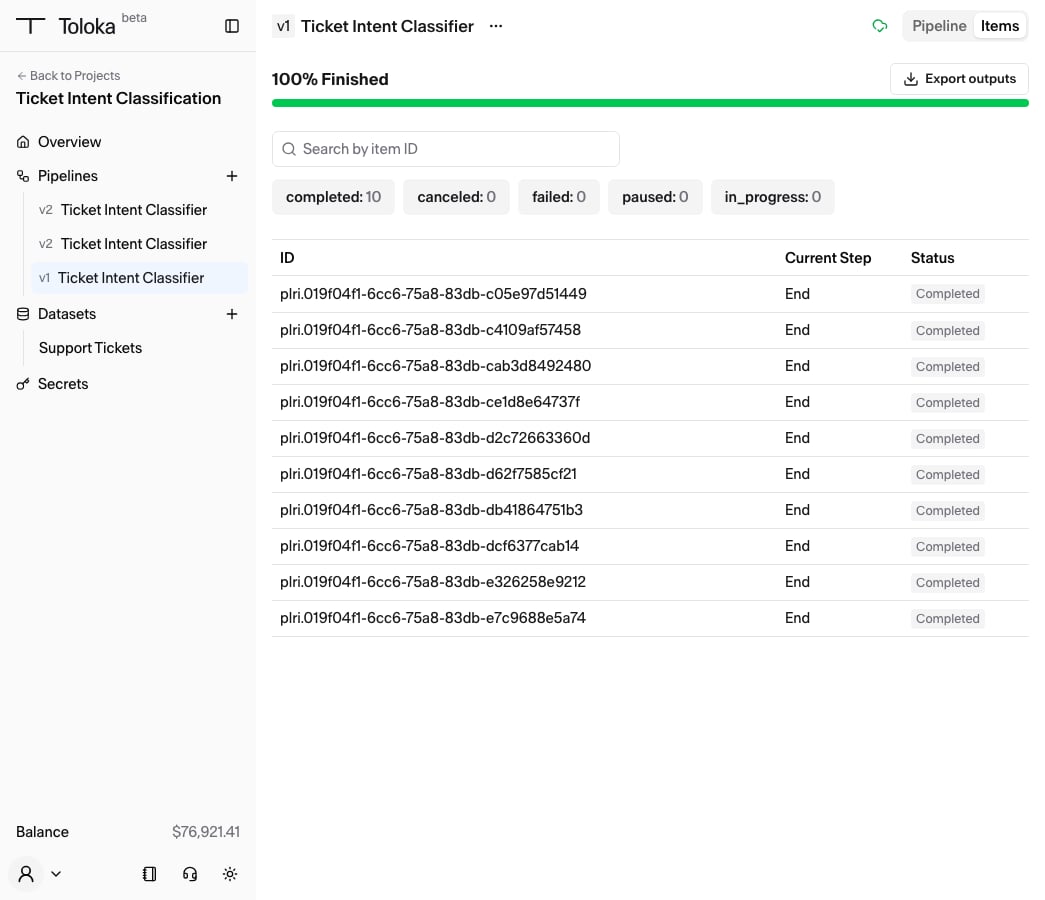
Step 2 — Start an export
Click Export outputs. The Exports popover opens. It reads No exports yet. the first time. Click New export. A confirmation reports the export has started, and a new entry appears in the popover with a climbing progress percentage. You can start another export at any time. Each one is listed separately with the time it was created.Step 3 — Wait for the export to finish
The export runs in the background and updates without a page refresh. When it finishes, the entry’s progress percentage changes to a green completed badge next to its creation time, and a download icon appears at the right end of the row.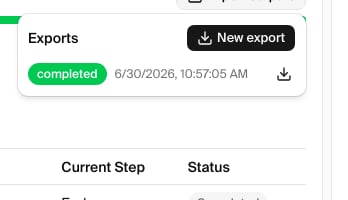
Step 4 — Open the export
Click the download icon (a downward arrow, tooltip Download) at the right end of the completed export’s row. The browser downloads the file, named after the pipeline, its version, and the moment you started the export. The results are a JSON list with one entry per item in the run. Export format contains the full contract, including the per-node metrics. A completed entry looks like this:index and status — one of completed, failed, cancelled (spelled so in the file), paused, in_progress, or idle for an item that never started. Its input fields, the output fields of a completed item, the partialOutput fields of a canceled item, and per-node metrics (such as timing, attempts, and labeler IDs) appear only when the item has them, as of the moment you started the export. An item that had not started carries only its index and status; an item still in progress carries its inputs but not yet its outputs.
A canceled item has the status cancelled and no output. If a node wrote at least one field selected by End before cancellation, partialOutput contains the selected fields that had values when the item was canceled. For example, an item accepted without review, on a run cancel or at the 14-day node timeout, carries its answer there when the End node returns it. See Items that wait for Human QA.
Each click of the download icon generates a fresh link. If it expires, click the icon again; the export stays in the list.
Related
- Prepare training data from labels — turn completed export rows into training examples
- Label, train, and evaluate — continue from a completed labeling export into the cross-product workflow
- Label a large dataset in batches — merging exports across batches and the batch cycle that produces them
- Fields and data — the input and output fields in the file